Baserow
Open-source, self-hostable no-code database — the Airtable alternative where you own your data. Build custom apps on top of your tables with a powerful API.
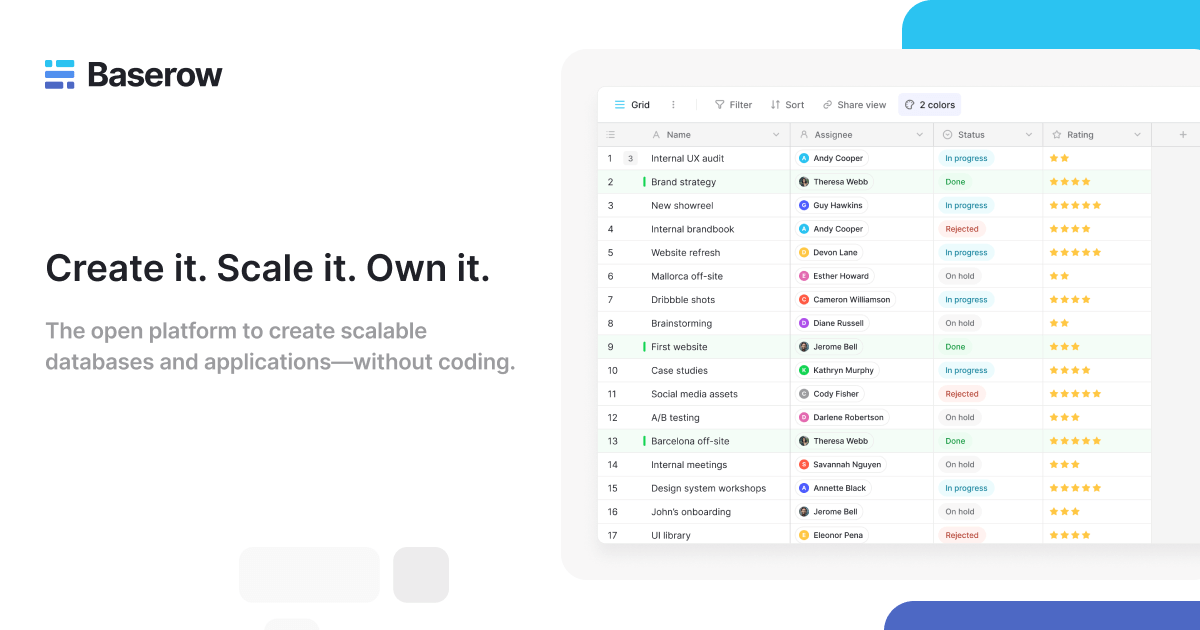
Baserow, as it opens in a browser tab.
Not sure how to add Baserow to your home screen? Step-by-step for Chrome, Safari, Firefox and Edge — it takes about ten seconds, and there is no app store involved.
Own Baserow? Have us re-run this measurement — we open it in a real browser, cut the network, and send you what survived.
How to install Baserow as a PWA
Screenshots
Are you the maker of Baserow? Claim this listing →
Similar to Baserow

Open-source spreadsheet-database hybrid — like Airtable but self-hostable and free. Build relational tables with formulas, linked records, and custom views without monthly fees. Access rules run per row and per column, which is what usually forces teams off a plain spreadsheet.

Turn any database (MySQL, Postgres, SQLite) into a smart spreadsheet UI. The open-source Airtable alternative that works with your existing data infrastructure. It connects to an existing database rather than importing it, so the spreadsheet view and the app share one source of truth.

Open-source business intelligence tool. Connect to any database, build dashboards and charts without SQL. Teams use it to self-serve analytics without a data team. Questions can be asked in a visual builder or in SQL, so analysts and non-analysts work on the same dashboards.

Local-first, privacy-native workspace — notes, databases, tasks in one place. End-to-end encrypted sync, open-source protocol. Your data lives on your device first, sync is optional.

The open-source web editor for slide decks — create, present, and share presentations from the browser, with live audience interaction. The project is now archived: the hosted editor is offline, but the code remains open source and self-hostable.

Open-source Notion alternative with offline-first architecture. Kanban, docs, grids, and calendar views. Your data is local by default — sync is optional. Built in Rust and Dart.
Own a PWA? See the listing options — standard submission is free.